30 Riddles With Answers: From Easy to Hard
Thirty riddles with answers, sorted from easy to hard, with answers hidden until you tap. Great for kids, classrooms, road trips and family game night.

Twenty math riddles and logic puzzles with hidden answers and clear explanations, from quick number tricks to classic river-crossing and weighing puzzles.
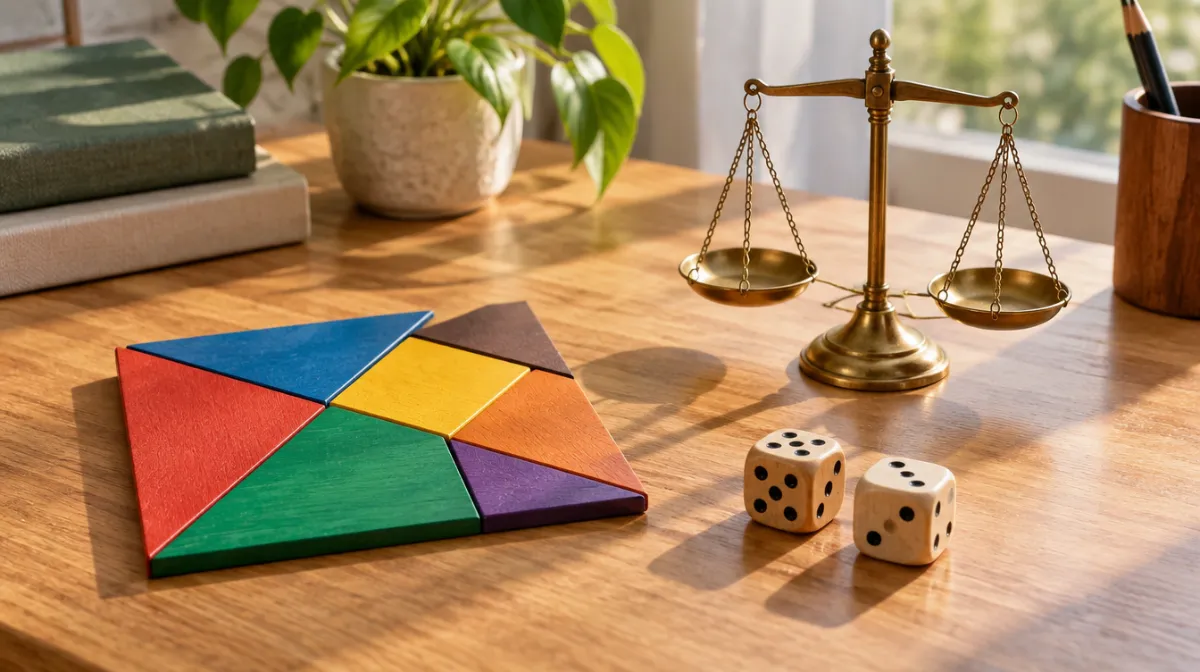
Math riddles are jokes for the logical brain: the answer is usually simpler than it looks, and the fun is in spotting the trap. These twenty start with quick number tricks and build to classic logic puzzles. Answers are hidden, each with a short explanation so nobody feels cheated.
Nine.
Seven. Remove the S and you get “even.”
888 + 88 + 8 + 8 + 8 = 1,000.
67. She was 3 when you were 6, so she is always three years younger.
70. Dividing by a half is the same as multiplying by 2: 30 ÷ ½ = 60, plus 10.
Nine. “All but 9” means nine stayed put.
1, 2 and 3. Both 1 + 2 + 3 and 1 × 2 × 3 equal 6.
5 cents. The bat is then $1.05. If the ball were 10 cents, the bat would be $1.10 and the total $1.20.
5 minutes. Each machine makes one widget in 5 minutes.
Day 47. It doubles on the last day, so it was half the size the day before.
11 seconds. Six strikes have five one-second gaps; twelve strikes have eleven.
On day 8. After seven days and nights it is 7 feet up. On day 8 it climbs the last 3 feet and escapes before it can slide back.
Take the goose across. Return and take the fox, then bring the goose back. Take the grain across and leave it with the fox. Finally, go back for the goose.
Fill the 5-liter jug and pour it into the 3-liter jug, leaving 2 liters. Empty the small jug and pour the 2 liters in. Refill the big jug and top up the small one, which takes 1 liter. Exactly 4 liters remain.
Turn on switch 1 for a few minutes, turn it off and turn on switch 2. Go in. The lit bulb is switch 2, the warm dark bulb is switch 1 and the cold dark bulb is switch 3.
Light rope A at both ends and rope B at one end. When A burns out after 30 minutes, light the other end of B. It burns out 15 minutes later.
Weigh three against three. If they balance, weigh the last two against each other. If one side is heavier, weigh two balls from that side; if they balance, the third is the heavy one.
13. Each number is the sum of the two before it: the Fibonacci sequence.
36. These are the square numbers: 1², 2², 3² and so on.
N, for Nine. They are the first letters of One, Two, Three…
| Puzzle type | Good for | What it trains |
|---|---|---|
| Quick number riddles | Ages 7 and up | Reading carefully |
| Trick questions | Teens and adults | Slowing down before answering |
| Logic puzzles | Ages 10 and up | Step-by-step planning |
| Sequences | Everyone | Spotting patterns |
Stuck? Draw it. A quick sketch of the riverbank or the jugs makes most logic puzzles click. For more head-scratchers, try our brain teasers for adults, or for younger solvers, riddles for kids.
Yes. They teach children to read a problem carefully, test an idea and explain their thinking. Start with the quick number riddles and save the logic puzzles for ages ten and up.
The fast answer, 10 cents, feels right, so most people never check it. It’s a famous example of intuition beating careful reasoning.
Use real objects: coins for the weighing puzzle, cups for the jugs and toy animals for the river crossing.

Every article is edited by a human and checked against our editorial policy. Spotted a mistake? Tell us.
Thirty riddles with answers, sorted from easy to hard, with answers hidden until you tap. Great for kids, classrooms, road trips and family game night.
Twenty-five fun riddles for kids with answers hidden until they tap, sorted from easy to tricky. Great for classrooms, car journeys and screen-free family time.
Twenty-two brain teasers for adults, from lateral-thinking puzzles to logic and probability classics, with answers hidden until you’re ready to check.